
A ÚLTIMA BOBINA DE FILME SUPER 8 QUE VOCÊ FILMOU
Multimedia installation
“…how stories are recorded, in what kind of physical media, what kind of processes and durations…”
— Jussi Parikka, introducing the media archaeology of Wolfgang Ernst
“Personal experiences—revised and in other ways redrawn—become a lens with which to reread and rewrite the cultural stories into which we are born.”
— Gloria Anzaldúa
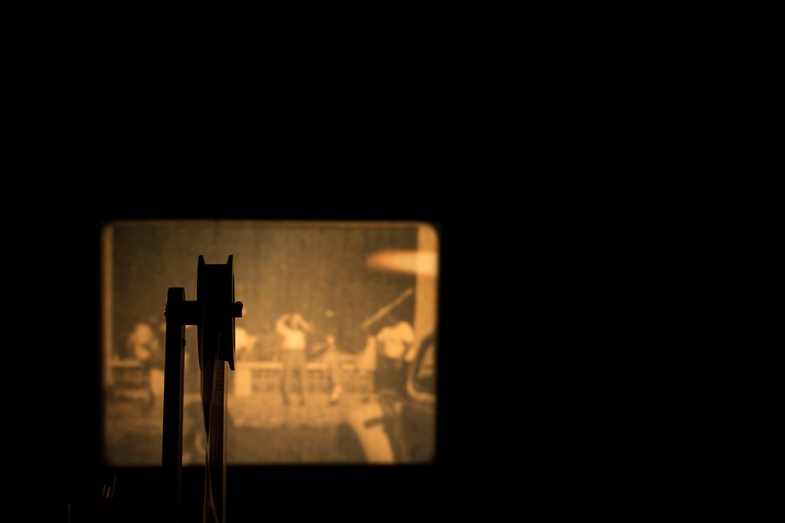
During the 1980s, my father, an electrical engineer, filmed our everyday life in Brazil with a Super 8 camera. I grew up watching these images projected, fascinated not only by what appeared on the screen but by the movement of the film itself: the reels turning and then reversing as the footage was rewound. Rewinding seemed to unweave time so that it could begin again.
In 1990, my father decided to return to Chile, his homeland. He never filmed again. The final roll he exposed remained undeveloped inside its box until, after his death, I encountered it again in 2014.
A última bobina de filme Super 8 que você filmou (The Last Roll of Super 8 Film You Shot) began by following the thread of my personal and family memory, in an attempt to discover what images, memories, and fragments of time had remained stored in this last roll. The film waited for more than two decades. It outlived the person who recorded it, travelled thousands of kilometres across countries and continents, and eventually returned to its place of origin to be developed.
The project takes translation as both a material operation and a conceptual framework. It reflects on the relationship between cinema and textile as historical systems for recording, storing, and transmitting information and narratives.
For the installation, my father’s Super 8 film was transferred to 16 mm. Information from the film was then converted into binary code and transcribed onto punched cards that could be read by an old Jacquard loom. Through this process, the moving image was translated into a woven tapestry: cinematic frames became coded instructions, and those instructions became textile structure.
Each transfer—from Super 8 to 16 mm, from film to binary code, from punched card to woven surface—changes the form through which the memory can be perceived. The tapestry is not simply a reproduction of the film, but another material inscription of the information it contains.
The installation also approaches the footage through personal and interpretative memory. After digitising the film, I sent it to my mother in Chile and recorded her responses as she watched it from a distance. Her attempts to identify places, people, dates, and situations repeatedly encounter uncertainty: “No se ve nada”; “¿Ves lo mismo que yo?” Fragments of her speech reappear as projected text, accompanied by a sound work constructed from memories of the film and of my father.
Rather than reconstructing a single account, the installation brings together film, code, punched cards, textile, sound, text, and recollection as different ways of encountering the same material record. What persists is not an intact memory, but a history continuously transformed through its media, its journeys, and its successive interpretations.
Produced and presented at Le Fresnoy – Studio national des arts contemporains, France, 2014.


Production: Le Fresnoy Studio National des Arts Contemporains (France). Exhibition Panorama 16, Solus Locus, 2014. With the support of: Textiles Castell (México) and FONDART, Becas y Pasantías (Chile)
Remerciements a / Agradecimientos a / Thanks to : Le Fresnoy, Studio national des arts contemporains et notamment / especialmente a / especially a Pascal Buteaux, François Bonenfant, Sebastien Cabour, Richard Campagne, David Chantreau, Valérie Delhaye, Daniel Dobbles, Amélie Dubois, Jacky Lautem, François Lescieux, Jean-René Lorand, Thierry Maes, Alisha Molter, Margot Priem, Éric Prigent, Pascale Pronnier, Cyprien Quairiat, Ben Rivers, Blandine Tourneux, Madeleine Van Doren, Antoine Weffling. / Textiles Castell, Ernesto Codina, Jordi Codina, Miguel Codina, Martin Hernandez. Enetex, Enrique Elizalde, Nuri San Elizalde, Isabel Hernández. Ainsi que / así como / as well as David Ayoun, Marie-Thérèse Champesme, Alice Furtado, Paul Guilbert, Raphael Holt, Diana Lopez-Font, Guillaume Meigneux, Paola Moreno, Jorge Palomino C., Pamela Palomino, Enrique Ramírez, Bertrand Rigaux, David Rodes, Patricia Ruiz, Anna Katharina Scheidegger, Clio Simon, Constanza Urrutia-Wegmann, Kevin Voinet.
View A ULTIMA BOBINA at Diáspora — Centro Nacional de Arte Contemporáneo, Santiago, Chile, 2018


